 Previous
Clean Horizon and Nord Pool launch a new distribution initiative for the Clean Horizon Storage Index !

 March 17, 2026
 Clean Horizon delivers the latest snapshot of BESS performance across Europe – clear, concise, and focused on the trends that matter most to developers, investors, and policymakers.
Below is our latest snapshot of regional insights:
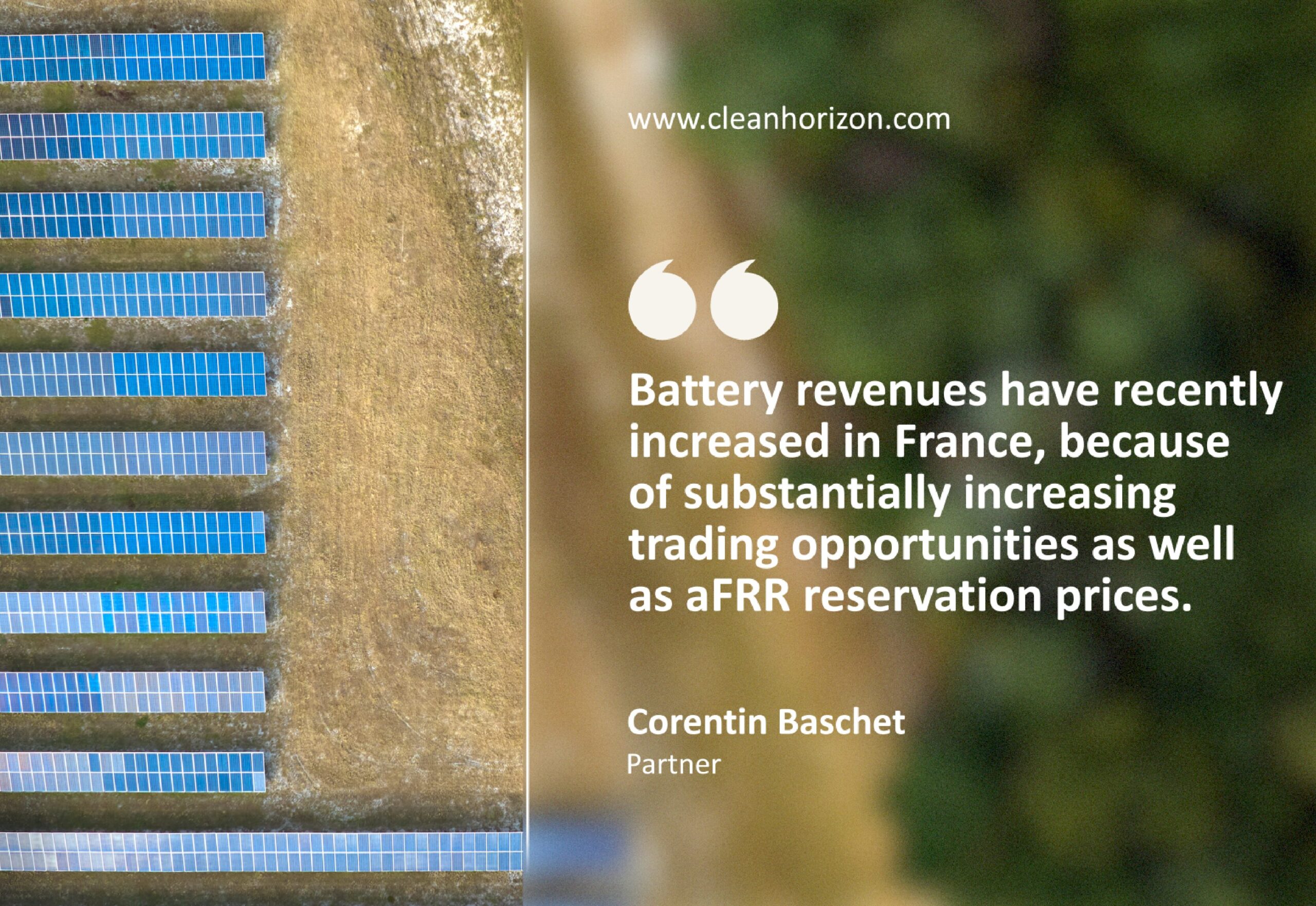
The index recorded back-to-back increases from December to January and from January to February. In February, revenues recorded a light growth, this was mainly driven by a slight rise in day-ahead spreads and aFRR capacity prices, resulting in an average increase of 5% across all battery configurations.
In February, day-ahead spreads decreased from 90 €/MWh to 73 €/MWh in Germany, due to a decline in electricity demand whilst wind power generation remained high. As for other markets, reservation prices on FCR and aFRR remained stable compared to January, while aFRR energy spreads increased, which partially compensated for day-ahead revenus losses. Overall, the profitability of BESS of all durations has decreased by 13% to 15%.
February electricity consumption in Estonia hit a record high — up 17% year-on-year — driven by cold weather. With cheap generation scarce across the whole Baltic region, Estonia leaned heavily on fossil fuels both domestically and via imports, keeping prices and spreads high (182€/MWh). Overall, revenues for a 2-hour BESS slightly increased to 548 k€/MW/year, by 9% compared to last month, supported by increasing mFRR capacity reservation market revenues. The FCR market remains the main revenue driver for batteries, accounting for 51% of total revenues.
This month, BESS revenues slightly increased, with similar price levels across capacity markets, while energy markets’ volatility rose. The day-ahead market reached an average hourly spread of 150€/MWh while the mFRR EAM spread averaged 292€/MWh. The combination of low capacity clearing prices and high volatility lead to energy trading accounting for around 80% of total revenues for a 2-hour BESS.
Revenues increased in February compared to January, driven by wider market spreads. Day-ahead spreads rose by 23%, while spreads in aFRR energy and mFRR energy increased by 40% and 23%, respectively, contributing to higher overall revenues.
In February, day-ahead spreads decreased from 90 €/MWh to 73 €/MWh in Germany, due to a decline in electricity demand whilst wind power generation remained high.
As for other markets, reservation prices on FCR and aFRR remained stable compared to January, while aFRR energy spreads increased, which partially compensated for day-ahead revenus losses.
Overall, the profitability of BESS of all durations has decreased by 13% to 15%.
Spreads on MSD and MB remain low, and revenues from these markets are consequently negligible, with virtually no contribution observed.
The Italian index is primarily driven by intraday revenues, with the revenue share varying significantly across zones. SARD records the lowest contribution, while SUD is among the highest. This results in notable regional divergence, with the index declining in some areas, such as NORD, and increasing sharply—nearly doubling—in others, particularly SUD.
Latvia’s electricity consumption in February was 16% higher than a year ago, though down slightly from January. Local production covered nearly all domestic demand (99%). Fossil fuels dominated the mix at 70.6%. The Latvian Day-Ahead spread remained to 182€/MWh. Revenues for a 2-hour BESS reached 615 k€/MW/year, increased by 15% compared to January 2026, with higher mFRR capacity reservation revenues. The FCR market remains the main revenue driver for batteries, accounting for 42% of total revenues.
Lithuania’s average Day-Ahead spread in February remained high (182 €/MWh). Low temperatures and costly Finnish imports kept prices elevated. Revenues for a 2-hour BESS increased to 575 k€/MW/year, up 10% month-on-month, helped by higher mFRR capacity reservation revenues. The FCR market remains the main revenue driver for batteries, accounting for 44% of total revenues.
After January’s prices spike, ancillary services reservation prices and day-ahead spreads went back to December’s level, with a 55% drop on average across FCR, aFRR and mFRR prices. Day-ahead spread settled at 93€/MWh, a 36% drop compared to January. These levels are in line with a lower volatility on the market due to lower renewable production during winter days, the same phenomenon that has been observed last winter. As a result, the 2h BESS index has almost been halved, going from 605 to 370 k€/MW/year.
In February, BESS revenues in Portugal decreased by 35% on average for all BESS durations. This is mainly driven by a decrease in the aFRR reservation prices upwards and downwards, as well as the accessible spreads on the DA, ID, aFRR activation and mFRR.
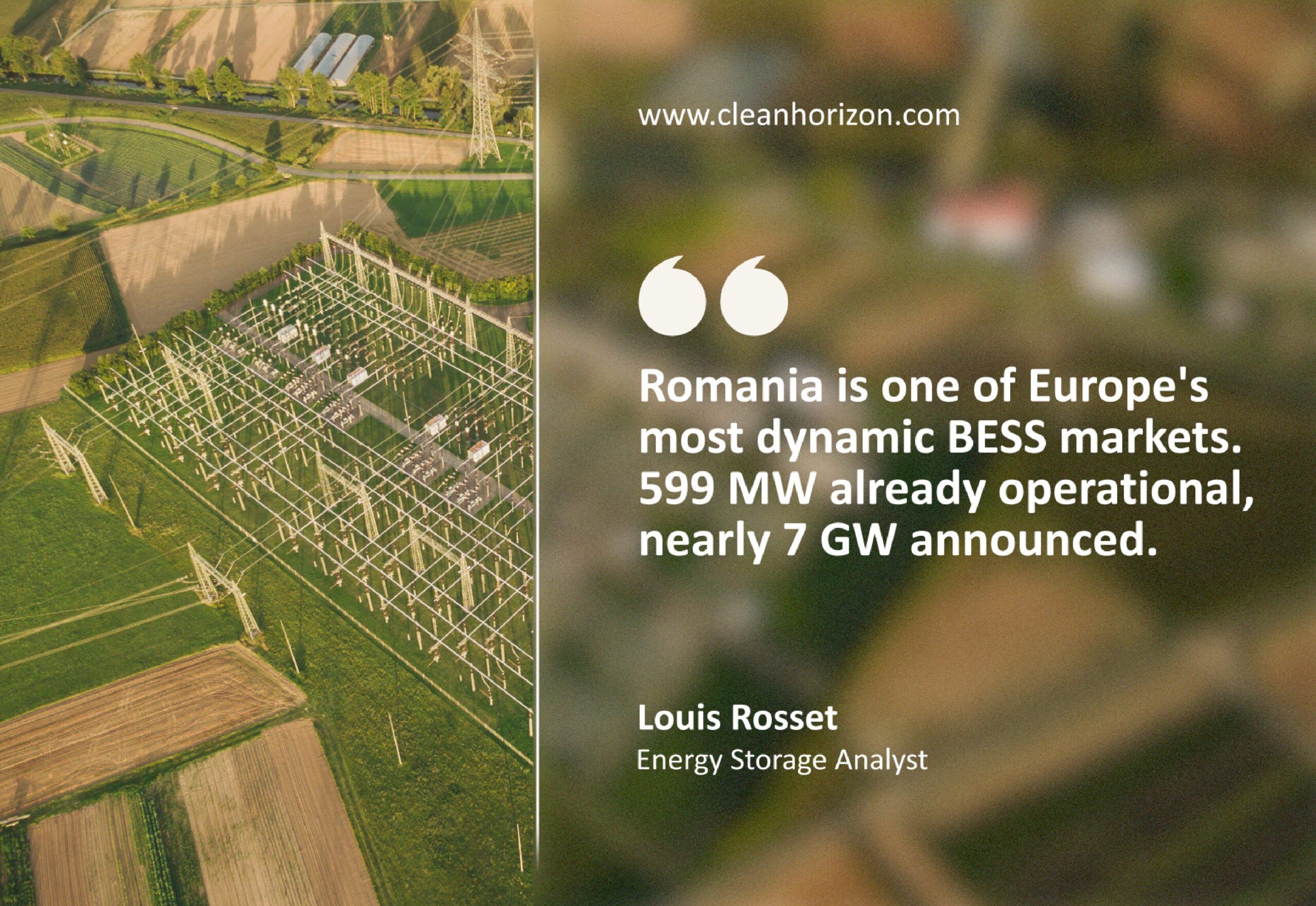
In February, BESS revenues in Romania decreased by around 10% on average. This decline is mainly driven by a reduction in Day-Ahead spreads, while revenues from other markets remained relatively stable. Although aFRR spreads are at a similar level to last month, batteries have shifted their operation towards more aFRR energy and less Day-Ahead trading due to the lower spreads. This results in higher revenues from aFRR energy, partially offsetting the decline in Day-Ahead revenues.
In February, BESS revenues in Spain decreased by 17% on average for all BESS durations. This is mainly driven by a decrease in the aFRR reservation prices upwards, as well as the accessible spreads on the ID, aFRR activation and mFRR.
FCR capacity prices increased by 30% and mFRR by 5%, while the 2-hour index has nearly doubled. As in the previous month, the main driver behind these index levels is the updated methodology, which now captures market volumes and active BESS capacity (in MW) across each market in a revised manner.
___________________
For deeper, high-frequency insights, explore the Premium Index – our advanced analytical tool designed to support strategic decisions and maximise storage asset performance.
Contact the Clean Horizon team to learn how the Premium Index can support your energy storage strategies.