 Previous
France's BESS market in 2026: revenue optimisation and grid integration

 July 11, 2026
 As ancillary service markets become increasingly competitive across Europe, many investors are asking whether battery storage can still deliver attractive long-term returns.
Our analysis suggests that the answer is yes, but the business model is changing.
Here you can find the key takeaways from Michael Salomon’s session at Green Univers conference dedicated to the financing of energy infrastructure!
Ancillary service revenues are declining across many European markets as competition intensifies.
But this does not necessarily weaken the investment case for battery storage.
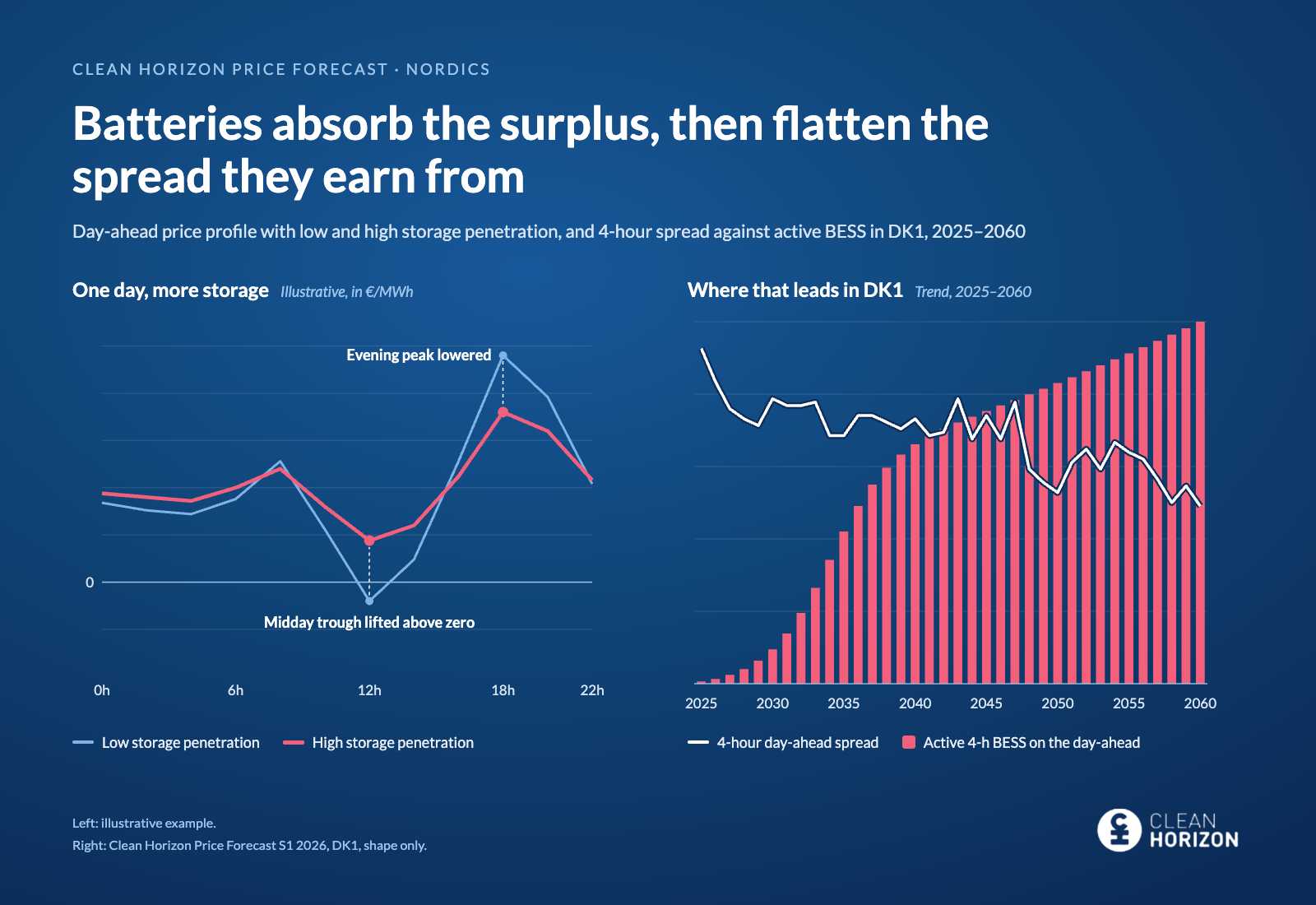
Instead, revenue stacks are gradually shifting towards energy trading, with day-ahead and intraday markets expected to become the primary long-term revenue source for many projects.
To answer this question, Clean Horizon compared:
→ the average TB4 day-ahead spreads over the lifetime of a project (2030-2048)
→ the 2030 Levelised Cost of Storage (LCOS) of a 4-hour battery (adjusted where relevant to account for capacity mechanism revenues).
The results are simple:
In several European markets (including Belgium, France, Romania, Germany and Portugal) expected wholesale price spreads alone remain above the cost of storage, suggesting that day-ahead trading could sustain long-term project profitability, even before considering additional revenue streams.
For others, the view is less simple.
Understanding how these revenue streams evolve over time is becoming essential for building robust, bankable business cases.
Would like to discuss Europeans storage markets, long-term revenue outlooks or project opportunities? Let’s talk!